
Showing posts with label geometry. Show all posts
Showing posts with label geometry. Show all posts
Saturday, August 26, 2017


Thursday, January 5, 2017
Snail's Trail Quilt Square
 I created this GeoGebra applet based on a quilt square pattern to use in a precalculus class as a visual introduction to the sum of an infinite geometric series. A nice accompaniment is this applet from Irina Boyadzhiev. I also created a Desmos activity with a focus on asking questions which incorporates these two applets.
Sunday, March 22, 2015
Rotational and Reflectional Symmetry
 I used GeoGebra to create this applet for exploring the rotational and reflectional symmetry of a variety of images.
Friday, March 20, 2015
Euclid: The Game
 Complete with a high score list, Euclid: The Game, created by Kasper Peulen using GeoGebra, presents you with a series of compass and straightedge challenges which get progressively more difficult as you move through the levels. You earn a gold medal for completing a level in the minimum number of moves. See if you can get all the way from constructing an equilateral triangle to inscribing a pentagon in a circle!
Tuesday, July 9, 2013
Compass and Straightedge Construction Challenges
 Ancient Greek Geometry from Nico Disseldorp's Science vs. Magic is a simple but elegant applet which gives compass and straightedge constructions the feel of a game. You start with two points and are given a list of things to construct, along with the number of steps in which you ought to be able to complete each construction. Click on two points and you create a line segment between them. Click one point and drag and you get a circle centered at that point. You score when you complete each construction, and score more when you do it within the number of steps prescribed. The first task is Proposition 1 of Book 1 of Euclid's Elements. The applet works equally well on a tablet or a standard computer.
Friday, March 22, 2013
Mathmo

I did experience a couple of minor bugs. Sometimes, the first time you look at a question you see the code rather than the mathematical notation. Clicking (or tapping) the question changes the code to notation. The description says that the color of the question changes once you indicate whether you got the question right or wrong. I didn't experience that either on the iPad or in Chrome.
Saturday, July 7, 2012
Indiana Puzzle Quilt

Check out the pattern in some real quilts, too!
Update 1/5/2017: See the Snail's Trail Quilt Square
Tuesday, June 19, 2012
Constructing the Area of a Circle

Thursday, July 7, 2011
A First Course in Algebra
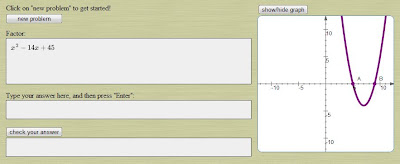 Dr. Carol J. V. Fisher has created a thorough online Algebra 1 course complete with interactive exercises for every topic. You can also choose to have a worksheet of practice problems and answers generated. I haven't explored the site that thoroughly yet, but there's a link to a beautifully formatted pdf text for each topic and the interactive web exercises are of good quality. I love that there's an option on the trinomial factoring problems to show the graph of the associated quadratic function!
There are also lots of interactive exercises for Geometry and Algebra 2.
Saturday, January 15, 2011
Solving triangles

Sunday, August 8, 2010
Turning a Circle into a Rectangle

Wednesday, August 4, 2010
Pythagorean Proof
 Jim Morey created this elegant interactive geometric proof of the Pythagorean Theorem.
Saturday, July 31, 2010
Law of Sines and Law of Cosines

Saturday, July 26, 2008
Interactive Algebra Practice

This site offers an easy to use interface for practicing a fairly wide variety of math topics. I especially like the "graphing" and "formulas" in the algebra section. In these problems, if you choose a difficulty level of 5 or higher you can choose linear graphs, quadratic graphs or a mix. When you have finished the set number of problems, you have the opportunity to redo the problems you got wrong.
Tuesday, July 24, 2007
Euclid's Elements


What's my angle?
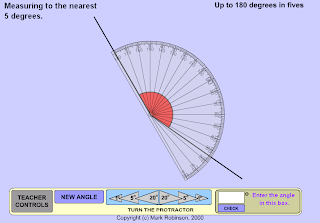
This is a nice little site to use for demonstrating how to use a protractor and for allowing students to get feedback on whether they are using the protractor correctly.
Sunday, July 22, 2007
GeoGebra

I have only briefly previewed this free software created by Markus Hohenwarter for exploring algebra, geometry, precalculus, and calculus, but I'm excited about the possibilities I see there! The geometric construction tools are reminiscent of those in Geometer's Sketchpad. The algebraic tools seem more extensive than in GSP. Associated with the software is the GeoGebraWiki site, where educators can post resources related to GeoGebra.
The National Library of Virtual Manipulatives
 This site from Utah State University has a nice collection of accurately named virtual manipulatives that can be used in K-12 math education. These are organized both by mathematical topic and by potentially appropriate grade level. I would say that the target audience for most is probably grades 3-8, but there are some which can be used by younger or older students. Each manipulative has clear instructions and notes for the teacher or parent. Many also have associated activities which can be accessed at the click of a button.
Subscribe to:
Posts (Atom)